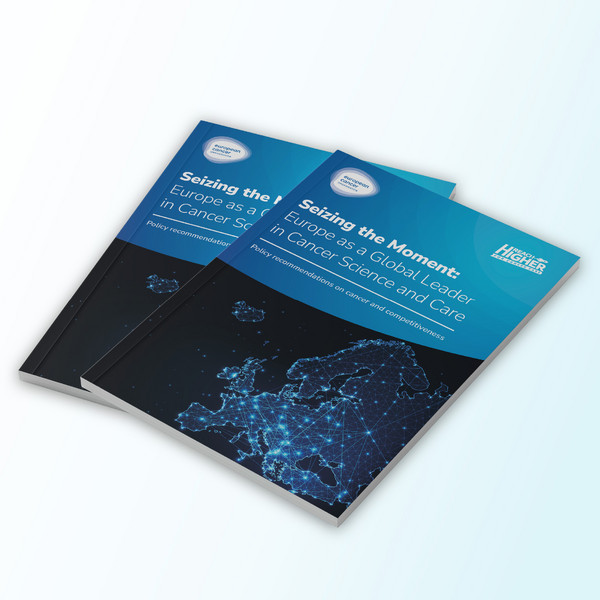
Seizing the Moment: Europe as a Global Leader in Cancer Science and Care
Policy recommendations on cancer and competitiveness
Europe is home to many of the world's leading cancer researchers, clinicians, scientific societies and healthcare institutions. European researchers continue to produce groundbreaking discoveries, develop exciting new technologies, and advance scientific knowledge. Yet too often Europe struggles to translate these achievements into rapid adoption, widespread implementation, and improved outcomes for patients. Scientific excellence alone is not enough.
As the EU embarks on an ambitious ‘competitiveness agenda’, oncology provides a valuable case study of what is needed to translate scientific excellence into tangible societal and economic value. Creating an environment in which scientific discoveries and new technologies can move efficiently from the laboratory into clinical practice will strengthen both the health of Europe’s citizens and the resilience of its economy. Understanding and addressing the barriers to implementation, strengthening collaboration between research and healthcare systems, and creating the conditions needed to attract and sustain investment can help Europe translate more of its scientific potential into better outcomes for patients, while reinforcing its position as a global leader in life sciences.
A Summary of Recommendations
1. Build a much more attractive environment for cancer research and technology development in Europe
- Make Europe’s leadership in advancing new technologies for cancer treatment and control a flagship priority of the EU Competitiveness Agenda.
- Sustain and expand long-term investment in Europe's Beating Cancer Plan and the EU Cancer Mission beyond the current Multiannual Financial Framework period as an available means to support this goal.
- Develop a dedicated European Strategy for Cancer Research, Development and Implementation, bringing together research, industrial, regulatory and health policy to strengthen Europe’s capacity to translate scientific discoveries into better cancer prevention, diagnosis and treatment.
- Recognise that creating the conditions for faster development and uptake of new approaches in cancer treatment and care is both a health priority and an economic competitiveness priority.
2. Make Europe a preferred location for generating real-world evidence, cancer research and clinical trials
- Establish Europe as a region where high-quality clinical trials in cancer can be initiated promptly, without compromising patient safety.
- Implement the recommendations of the Reducing Bureaucracy in Clinical Trials coalition.
- Improve hospital contracting, ethics processes, site activation and patient recruitment, where current delays are greatest.
- Support a European agenda for networks of Comprehensive Cancer Centres and strengthen their capacity for research collaboration.
- Increase support for investigator-led and multinational academic cancer trials.
- Support the development of federated clinical registries and electronic health records (EHRs) to complement evidence that cannot be generated through clinical trials, and to support and accelerate the decision-making process (from regulatory approval to health technology assessment (HTA).
3. Improve European leadership and coordination
- Bring forward enhanced European governance arrangements capable of providing long-term and highly effective coordination of cancer research, development and health policy, at a level that can help Europe compete globally over the long term.
- Establish a European observatory to monitor emerging scientific, technological and regulatory challenges earlier and respond more rapidly.
- Utilise Europe’s active community of scientific societies, healthcare professional organisations, patient associations and academic and research centres (‘the cancer community’) as permanent strategic partners in shaping competitiveness policy for cancer treatment and care, including workforce development, skills and the implications of AI for healthcare.
- Develop measurable European indicators tracking research performance, clinical trial activity, the uptake of new approaches and technologies, and patient access to care and treatment.
Download the full report here.