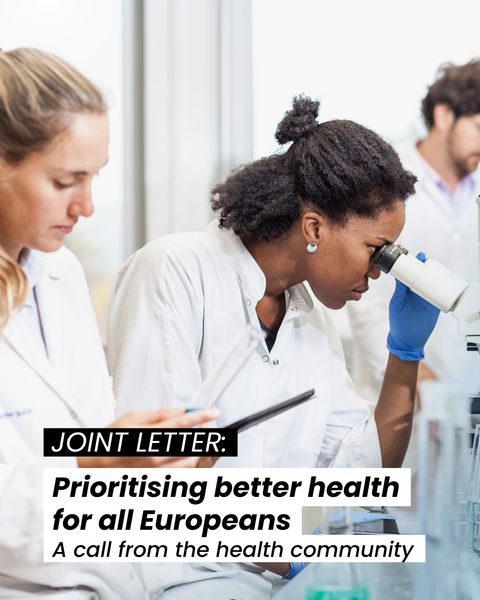
Key opinion leaders call for a strong EU health budget
June 2026
Every year, Europe loses a staggering €442 billion in productivity because of avoidable deaths linked to non-communicable diseases, according to the World Health Organization.
Yet, as negotiations intensify over the European Union’s next Multiannual Financial Framework (MFF), there is a real risk that health slips down the political agenda at precisely the moment Europe is placing competitiveness, resilience and economic security at the centre of its future strategy.
 ‘Europe cannot hope to compete globally while its citizens are held back by preventable illness and unequal access to care. Investing in health is not separate from Europe’s competitiveness agenda; it is a fundamental part of it,’ said Isabel Rubio, President, European Cancer Organisation.
Today, more than 490 healthcare experts, researchers, academics, and patient advocates from across disease areas are issuing a united warning: Europe cannot build a competitive economy without a healthy population. The mobilisation represents one of the largest coordinated actions by the European health community on the future of an EU budget.
 In a joint letter addressed to European Commission President Ursula von der Leyen, President of the European Council António Costa, and EU Member State governments, the coalition ‘calls for health to be established as a clear strategic priority, underpinned by a dedicated and ringfenced EU budget,’ said Minerva Becker, Chairperson, Board of Directors, European Society of Radiology.
The intervention comes at a pivotal moment. The European Parliament adopted its position on the next MFF in March, strongly supporting a dedicated health investment of €10 billion. Across Europe, this is seen as a strong signal that the well-being of its citizens must remain central to the negotiations.
Attention is now turning to member states, which will shape the Council’s position in the negotiations. Some member states have already begun expressing support for a stronger health investment, but broader political mobilisation will be required in the months ahead.
 ‘Health is not a cost to be managed, but an investment in Europe’s resilience, productivity, and social cohesion,’ said Konstantinos Makrilakis, President, Hellenic Diabetes Association. ‘Europe cannot speak of competitiveness, resilience, and strategic autonomy while weakening investment in health. A dedicated EU health budget is fundamental for the future wellbeing and security of European citizens.’
 Patient organisations echoed the call: ‘A European Health Union cannot exist without meaningful and protected investment in health. The next EU budget must reflect the political commitment to place citizens’ health at the heart of Europe’s future.’ said Marzia Zambon, Executive Director, Europa Donna.
As negotiations on the next EU long-term budget intensify, the signatories say the choice facing Europe is clear: either invest strategically in prevention, healthcare systems and citizens’ wellbeing now, or bear the social and economic consequences of underinvestment later.
 ‘A workforce held back by chronic illness is an economy held back,’ said Caroline Costongs, Director, EuroHealthNet.